Coffee bags · roasters and brands
Custom coffee bags: one design per origin, with valve and zipper.
Request a coffee bag proposalEvery lot deserves its own bag. With digital printing the artwork changes by origin, roast or season without plates, while the format stays the same so production is repeatable. This page organizes the decisions a roaster makes before requesting a proposal: format, size, valve, closure, material and mandatory label space.
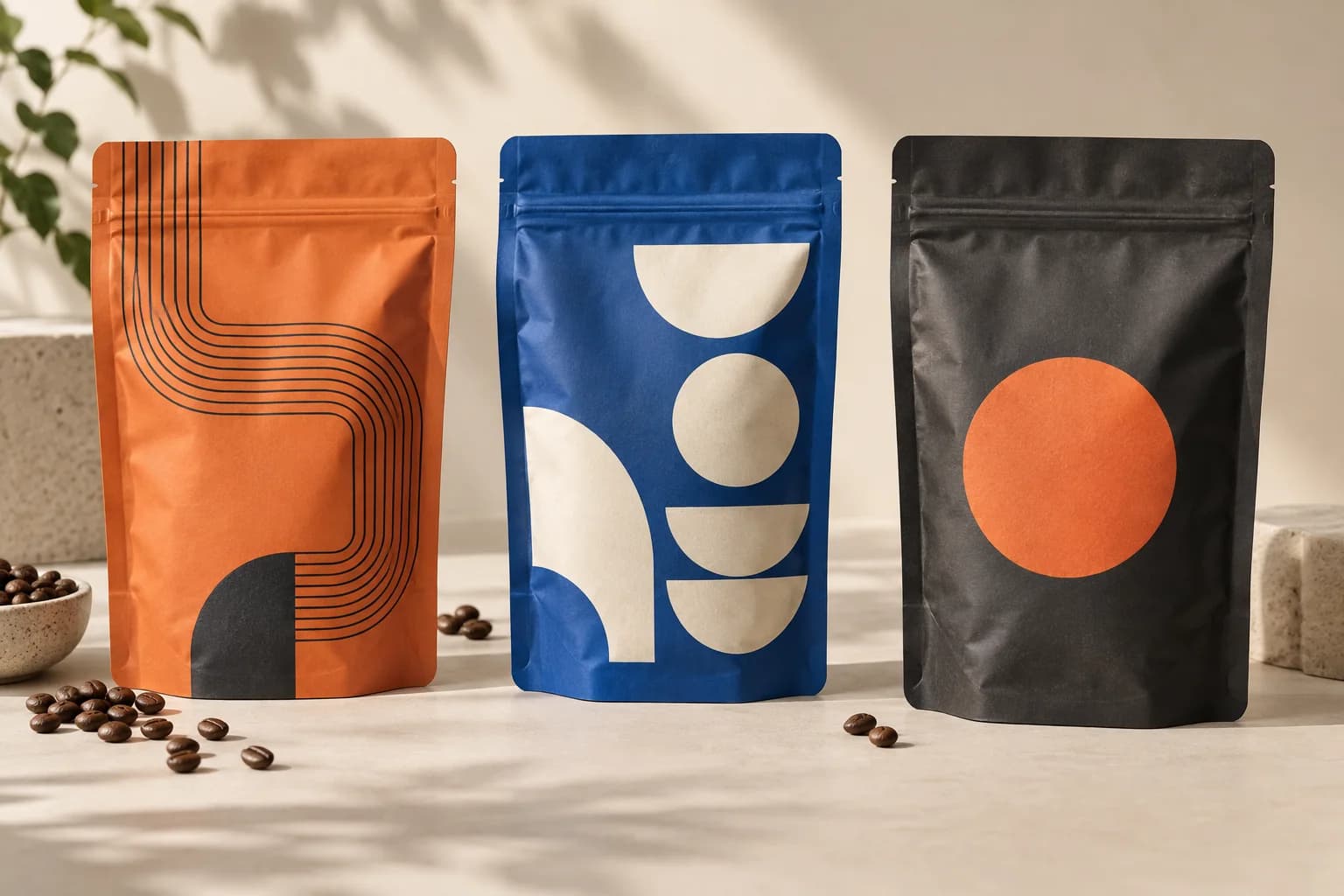
Six decisions before you quote a coffee bag
You do not need to settle all of them today. Mark the ones you know and leave the rest as questions for the proposal.
- 01
Format
Stand-up (doypack) with a bottom gusset for shelves and online sales; side-gusset, the classic roaster format with a narrow front; flat-bottom (block bottom) when you want more shelf presence and a firm base for 500 g or 1 kg. All three take a valve and a zipper.
- 02
Size and dimensions
The common sizes are 250 g, 500 g and 1 kg. Manufacturers publish reference dimensions per size, for example 11 × 19 + 7 cm or 13 × 22 + 7 cm for 250 g and 24 × 31 + 10 cm for 1 kg, with the advice not to fill a bag beyond two thirds. Whole beans take more volume than ground coffee; validate with your own coffee before fixing a size.
- 03
Degassing valve
Freshly roasted coffee releases CO2 for days. A one-way valve opens when internal pressure rises, lets the gas out and closes so oxygen does not get in. That is why coffee can be packed soon after roasting without the bag swelling. Filtered valves exist for ground coffee.
- 04
Closure
A zipper so customers can reclose at home; a tin-tie on traditional side-gusset bags; or only a tear notch if the coffee is consumed quickly. A zipper adds material and a zone the artwork must respect.
- 05
Material and finish
Coffee is sensitive to oxygen, moisture and light. Typical structures combine a printed layer (PET, kraft paper or matte film) with a barrier (metallised or aluminium) and a sealing layer (PE). A clear window shows the beans but lowers the barrier. Matte, gloss, kraft or metallic are brand choices; the exact structure is confirmed by production against your product brief.
- 06
Mandatory information and per-lot artwork
Reserve space on the dieline for the label information your market requires; in Mexico NOM-051 sets what goes on the main display surface and the rest of the label, in the US and Canada the food-labelling rules differ. With digital printing, origin, farm or roast date can change per design within the same order.
Reference coffee formats
Dimensions and capacities published by manufacturers as a starting point. Real capacity depends on coffee density, gusset and filling; the final size is confirmed with samples.
| Format | Used for | What to check |
|---|---|---|
| Stand-up with zipper, 250 g | Launches, online sales, cafés with their own shelf | Reference dimensions 11 × 19 + 7 cm to 13 × 22 + 7 cm; valve on the front or back depending on the artwork |
| Stand-up or flat-bottom, 500 g | Subscriptions and repeat customers | Reference dimensions around 15 × 25 + 7 cm to 19 × 26 + 11 cm; check standing stability with whole beans |
| Flat-bottom or side-gusset, 1 kg | Cafés, offices and wholesale | Reference dimensions around 24 × 31 + 10 cm; zipper or tin-tie, valve required for fresh beans |
| Three-side seal or sachet, 15 to 60 g | Samples, drip bags and tasting kits | No gusset; artwork on one main face; a way to test origins with little inventory |
What we will not assume
We do not publish a universal minimum, price or turnaround for coffee bags. Size, structure, valve, number of artworks and production availability change the proposal. A small order may carry a higher unit cost; we make that visible in the proposal rather than hide it.
What we need to prepare your proposal
You can start without final artwork and without knowing the structure. Share what you know and mark the rest as open.
Request a coffee bag proposal- 01Whole bean or ground, and grams per size
- 02Preferred format (stand-up, side-gusset or flat-bottom) or a reference pack
- 03Valve, zipper or tin-tie
- 04Number of origins or designs and quantity per design
- 05Country of sale and target date
Questions roasters ask
What bag size do I need for 250 g of coffee?
Manufacturers publish references between 11 × 19 + 7 cm and 13 × 22 + 7 cm, filling at most two thirds of the bag. Whole beans take more volume than ground coffee, so the size is confirmed by filling samples with your coffee.
Does my bag need a degassing valve?
If you pack soon after roasting, yes: the CO2 the coffee releases would swell a sealed bag with no outlet. The valve lets the gas out and keeps oxygen from entering. If your coffee rests before packing, the decision depends on your process.
Can I print several origins in one order?
Digital printing changes the artwork per design without plates. For several origins to share production they must match in size, structure and closure; tell us how many bags you want of each artwork and we review it.
Stand-up or side-gusset?
A stand-up bag stands on its own and shows a wide front on shelves and in photos; a side-gusset bag is the traditional roaster format and packs more efficiently in cases. Both take a valve and a zipper; the choice depends on your sales channel.
Which label information must the bag carry?
It depends on the country of sale: Mexico's NOM-051 defines what goes on the main display surface and the rest of the label; the US and Canada have their own food-labelling rules. We check that the artwork reserves the space; the product classification remains the brand's responsibility.
How many bags can I order?
It depends on the format, the structure and available production. Tell us your target quantity per design and we review it instead of promising a generic minimum.
Tell us what you are packing.
We turn the product, quantity per design and open questions into a reviewed proposal, not an automatic price that ignores the specification.
Request a coffee bag proposal